

 |
| |
 |
| |
 |
| |
 |
| |
 |
| |
 |
| |
 |
| |
 |
| |
 |
| |
 |
| |
 |
| |
 |
| |
 |
By: Matt Johnson
Ice fishing is an art. Ice
fishing is a passion.
Ice fishing is what
drives people out onto
the frozen tundra day
after day in search of
a scaly critter. Ice
fishing is very much a
part of me, and if
you’re reading this, then
I assume that ice fishing
is very much a part of
you as well. We have a wide range of ice anglers. We have the recreational
ice angler, or someone who ventures out on the ice when time permits. We
have the avid ice angler, which is someone who makes time for ice fishing and
spends time reading articles, visiting tackle shops and making an effort to
make ice fishing a way of life. Then there is the diehard ice angler. This is
someone who lives, sleeps and breathes ice fishing. They can’t get enough of
it, and when they’re not doing it, all they’re thinking about is ice fishing. The
vision of their flasher sonar unit is imprinted on their brain and they find
themselves setting the hook while sitting in church. These are the diehards,
and they are a special breed. But what group do ice fishing guides get tossed
into? Are ice fishing guides out there because they love the sport, or are they
out there to dabble in the environment and learn a thing or two along the way?
Being an ice fishing guide, I can tell you, we’re here as extreme diehards!!
A day in the life of an ice fishing guide is a unique one. We not only live for the
thrill of the catch, but we live for the excitement that it brings to someone else.
Ask any ice fishing guide and they’ll tell you that the look on another happy
angler’s face is better than the satisfaction of catching it yourself. We thrive off
helping and seeing others catch fish, that’s what it’s all about. A chance to
watch a first time ice angler land their first fish, or a chance to watch an expert
land a new personal best, either way, it’s always a adventure and a joy to see.
Everyday brings a new challenge, and every challenge is welcomed with open
arms. Our job is to help others catch fish, and to make sure they have the best
time while doing it. So, let’s take a peek into the mind of an ice fishing guide
and see what kind of planning and thought takes place for a day on the ice…
It’s a brisk, early December morning and the forecast is looking like twenty
degree weather. I awake before the alarm sounds with anticipation of the day
to come. See, it’s Saturday morning, and I’m about to embark on a journey of
laughter, excitement, experience and hopefully of catching some fish. Yep, it’s
the start of a beautiful day, and it’s my first guide trip of the winter. I rise to my
feet only to find my fishing gear right where I left it the night before and
everything in place ready to go. See, as an ice fishing guide, we have to be
prepared and ready for the challenge. So this means we need to dot every “I”
and cross every “T”. We need all the proper equipment to be rigged and ready
for battle. We also need an understanding of where we’re going to bring the
clients when venturing out onto a lake, and that means prior scouting…
The day before a guide trip might seem like a free day of fishing, but it’s really
nothing of the sort. The day before a guide trip can be a lot of work and
frustration, but the rewards are well worth it. Punching a hundred holes might
seem extreme to some, but when on a hardcore fish search its common
practice. I like to have five or six spots picked out where I know there are fish,
so come the day of the guide trip I don’t fall flat on my face. If this means I
have to create a nice block of Swiss cheese over a fresh sheet of ice then so
be it. My goal is to find fish, and find as many as possible. When approaching
a lake I like to break it up into parts by looking at a lake map. Then once I
break it up into parts I approach each part as a separate lake. Each lake has
different characteristics and spots that look like potential fish holding areas. I
like to spend about an hour on each spot searching for fish. Once fish are
located I’ll keep track on either a map or a Global Positioning System (GPS) so
I can come back in the future. After one spot is covered I move onto the next
one. My goal isn’t always necessarily to catch fish, but to locate them. Some
days all I’ll bring with me is the auger and electronics. By electronics I mean an
underwater camera for locating structure and type of fish, and a flasher unit
for pinpointing depths and if there are fish even there. No need for a rod and
reel until I have a pattern down as to where the fish are. Once I feel confident
that I know of several different spots where the fish are, than I’ll grab the rod
and reel and find out what the fish are feeding on. Like I said, at this stage
catching fish isn’t the most important part, but locating fish is. If I can pick up a
few fish from every spot then that’s good enough for me. I’ll leave the rest for
the following day, when it becomes more critical that we catch fish.
So, now I have an understanding of where the fish are and what they are
feeding on. I have an assortment of baits and jigs that are working on the
desired target. I now have to make sure I have all the right equipment for a day
on the ice with the people I’m going to guide. I always like to create a checklist
to make sure nothing is left out…
Do I have enough rods, reels and tackle? Check. Do I have enough bait?
Check. Do I need an extra portable fish house? Check. Do I have enough
propane for the heaters? Check. Do I need a lantern? Check… and the list
goes on and on. This is a very important step in preparing for a guide trip. The
last thing I want is to find out that I forgot something when we’re out on the ice.
Remember, I want to make everything as enjoyable as possible for my clients,
and I want them to have every opportunity as possible to have a successful
day on the ice.
Now, I have my spots picked out, I have the gear ready for the following day
and I have enough energy to wind up a dozen ten year olds at Christmas. So,
what’s next? It’s now time to contact the people I’m going to guide tomorrow
and touch base. I like to keep in close contact with those that I guide. This
means that I touch base with them at least once a week from the time they
book the trip until the time of the trip. I want to make sure they know how to get
to the lake and to make sure everything is clear on where we’re going to meet
that morning. Communication between you and your clients is very important
and it can play a huge role in setting the mode of an ice fishing trip. A guided
ice fishing trip can be so much more than just a day of catching fish…
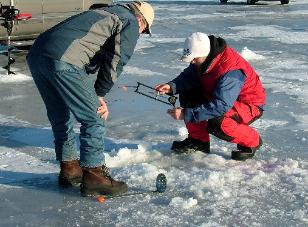
See, being a successful ice fishing guide doesn’t only mean that you can catch
fish, or that your clients catch fish, it’s much more than that. You want your
clients to enjoy the experience and walk away with the satisfaction that it was
time well spent when the day is done. And this doesn’t always mean you have
to catch fish. Catching fish is no doubt the reason why they hired you, but it
doesn’t always have to make or break the guide trip. Make the clients feel they
are out fishing with a friend, make them feel like they are part of “your team.”
Teach your clients about fishing, show them proper techniques, show them
how to use a slip-bobber if they don’t already know how, show them how to
work an underwater camera or a flasher unit, show them a good time. Make it
so that catching a fish is just a bonus. Too many guides feel that if they don’t
catch fish then the trip wasn’t a success and it doesn’t have to be that way if
you don’t want it to. When the fishing is slow (and we all know it can be no
matter what we do) show the clients some of the finer points of ice fishing.
Start a conversation, ask about previous ice fishing trips, and ask them if they
want to know anything. Don’t get bothered if the fish are not biting, it’s going to
happen, so make the most of it.
A day on the ice should be fun, not frustrating and boring. An ice fishing guide
plays an important role. People hire an ice fishing guide to help them catch
fish. People are looking for someone to show and teach them something new.
If the people who hired you didn’t feel like they could benefit from a day on the
ice with you then they would have never hired you in the first place. They are
willing to learn, and believe it or not, they want to ask a lot more questions
then they actually do. So instead of dwelling on whether or not the fish are
biting, get your clients involved and show them that an on-ice seminar is about
to take place. Ice fishing is about fun, and I’m honored to be an ice fishing
guide.
Ice fishing is an art. Ice
fishing is a passion.
Ice fishing is what
drives people out onto
the frozen tundra day
after day in search of
a scaly critter. Ice
fishing is very much a
part of me, and if
you’re reading this, then
I assume that ice fishing
is very much a part of
you as well. We have a wide range of ice anglers. We have the recreational
ice angler, or someone who ventures out on the ice when time permits. We
have the avid ice angler, which is someone who makes time for ice fishing and
spends time reading articles, visiting tackle shops and making an effort to
make ice fishing a way of life. Then there is the diehard ice angler. This is
someone who lives, sleeps and breathes ice fishing. They can’t get enough of
it, and when they’re not doing it, all they’re thinking about is ice fishing. The
vision of their flasher sonar unit is imprinted on their brain and they find
themselves setting the hook while sitting in church. These are the diehards,
and they are a special breed. But what group do ice fishing guides get tossed
into? Are ice fishing guides out there because they love the sport, or are they
out there to dabble in the environment and learn a thing or two along the way?
Being an ice fishing guide, I can tell you, we’re here as extreme diehards!!
A day in the life of an ice fishing guide is a unique one. We not only live for the
thrill of the catch, but we live for the excitement that it brings to someone else.
Ask any ice fishing guide and they’ll tell you that the look on another happy
angler’s face is better than the satisfaction of catching it yourself. We thrive off
helping and seeing others catch fish, that’s what it’s all about. A chance to
watch a first time ice angler land their first fish, or a chance to watch an expert
land a new personal best, either way, it’s always a adventure and a joy to see.
Everyday brings a new challenge, and every challenge is welcomed with open
arms. Our job is to help others catch fish, and to make sure they have the best
time while doing it. So, let’s take a peek into the mind of an ice fishing guide
and see what kind of planning and thought takes place for a day on the ice…
It’s a brisk, early December morning and the forecast is looking like twenty
degree weather. I awake before the alarm sounds with anticipation of the day
to come. See, it’s Saturday morning, and I’m about to embark on a journey of
laughter, excitement, experience and hopefully of catching some fish. Yep, it’s
the start of a beautiful day, and it’s my first guide trip of the winter. I rise to my
feet only to find my fishing gear right where I left it the night before and
everything in place ready to go. See, as an ice fishing guide, we have to be
prepared and ready for the challenge. So this means we need to dot every “I”
and cross every “T”. We need all the proper equipment to be rigged and ready
for battle. We also need an understanding of where we’re going to bring the
clients when venturing out onto a lake, and that means prior scouting…
The day before a guide trip might seem like a free day of fishing, but it’s really
nothing of the sort. The day before a guide trip can be a lot of work and
frustration, but the rewards are well worth it. Punching a hundred holes might
seem extreme to some, but when on a hardcore fish search its common
practice. I like to have five or six spots picked out where I know there are fish,
so come the day of the guide trip I don’t fall flat on my face. If this means I
have to create a nice block of Swiss cheese over a fresh sheet of ice then so
be it. My goal is to find fish, and find as many as possible. When approaching
a lake I like to break it up into parts by looking at a lake map. Then once I
break it up into parts I approach each part as a separate lake. Each lake has
different characteristics and spots that look like potential fish holding areas. I
like to spend about an hour on each spot searching for fish. Once fish are
located I’ll keep track on either a map or a Global Positioning System (GPS) so
I can come back in the future. After one spot is covered I move onto the next
one. My goal isn’t always necessarily to catch fish, but to locate them. Some
days all I’ll bring with me is the auger and electronics. By electronics I mean an
underwater camera for locating structure and type of fish, and a flasher unit
for pinpointing depths and if there are fish even there. No need for a rod and
reel until I have a pattern down as to where the fish are. Once I feel confident
that I know of several different spots where the fish are, than I’ll grab the rod
and reel and find out what the fish are feeding on. Like I said, at this stage
catching fish isn’t the most important part, but locating fish is. If I can pick up a
few fish from every spot then that’s good enough for me. I’ll leave the rest for
the following day, when it becomes more critical that we catch fish.
So, now I have an understanding of where the fish are and what they are
feeding on. I have an assortment of baits and jigs that are working on the
desired target. I now have to make sure I have all the right equipment for a day
on the ice with the people I’m going to guide. I always like to create a checklist
to make sure nothing is left out…
Do I have enough rods, reels and tackle? Check. Do I have enough bait?
Check. Do I need an extra portable fish house? Check. Do I have enough
propane for the heaters? Check. Do I need a lantern? Check… and the list
goes on and on. This is a very important step in preparing for a guide trip. The
last thing I want is to find out that I forgot something when we’re out on the ice.
Remember, I want to make everything as enjoyable as possible for my clients,
and I want them to have every opportunity as possible to have a successful
day on the ice.
Now, I have my spots picked out, I have the gear ready for the following day
and I have enough energy to wind up a dozen ten year olds at Christmas. So,
what’s next? It’s now time to contact the people I’m going to guide tomorrow
and touch base. I like to keep in close contact with those that I guide. This
means that I touch base with them at least once a week from the time they
book the trip until the time of the trip. I want to make sure they know how to get
to the lake and to make sure everything is clear on where we’re going to meet
that morning. Communication between you and your clients is very important
and it can play a huge role in setting the mode of an ice fishing trip. A guided
ice fishing trip can be so much more than just a day of catching fish…
See, being a successful ice fishing guide doesn’t only mean that you can catch
fish, or that your clients catch fish, it’s much more than that. You want your
clients to enjoy the experience and walk away with the satisfaction that it was
time well spent when the day is done. And this doesn’t always mean you have
to catch fish. Catching fish is no doubt the reason why they hired you, but it
doesn’t always have to make or break the guide trip. Make the clients feel they
are out fishing with a friend, make them feel like they are part of “your team.”
Teach your clients about fishing, show them proper techniques, show them
how to use a slip-bobber if they don’t already know how, show them how to
work an underwater camera or a flasher unit, show them a good time. Make it
so that catching a fish is just a bonus. Too many guides feel that if they don’t
catch fish then the trip wasn’t a success and it doesn’t have to be that way if
you don’t want it to. When the fishing is slow (and we all know it can be no
matter what we do) show the clients some of the finer points of ice fishing.
Start a conversation, ask about previous ice fishing trips, and ask them if they
want to know anything. Don’t get bothered if the fish are not biting, it’s going to
happen, so make the most of it.
A day on the ice should be fun, not frustrating and boring. An ice fishing guide
plays an important role. People hire an ice fishing guide to help them catch
fish. People are looking for someone to show and teach them something new.
If the people who hired you didn’t feel like they could benefit from a day on the
ice with you then they would have never hired you in the first place. They are
willing to learn, and believe it or not, they want to ask a lot more questions
then they actually do. So instead of dwelling on whether or not the fish are
biting, get your clients involved and show them that an on-ice seminar is about
to take place. Ice fishing is about fun, and I’m honored to be an ice fishing
guide.
| Matt Johnson Outdoors 2003-2004 |
MattJohnsonOutdoors.com
| Experience the Fishing |

Inside the Mind of An Ice Guide

Experience the Fishing...

| Tips and Articles |